
About us
The Science Dictionary is a specialized science search engine that queries billions of the web's top science pages for scientific information. The Science Dictionary was founded in 2006 and has since processed over three million (3,000,000+) queries. Every month, we receive over 250,000 page views from over 40,000 people worldwide who visit our site to learn more about a particular science topic. The Science Dictionary has been featured as a trusted resource by numerous educational institutes (K-12 and higher education) in the United States, the United Kingdom, and Canada. Researchers, students, and professionals around the world use The Science Dictionary as their goto website for finding relevant scientific information.
TDS vs Google
The Science Dictionary leverages Google's over one million servers and enormous web index of over 13 trillion web pages to perform its search queries. On top of Google's search index, The Science Dictionary has implemented a filtering system that determines which websites are trusted, science websites and which websites aren't.

In layman terms, every time you perform a search on The Science Dictionary, The Science Dictionary first accesses Google's 13 trillion page index to find matching pages. Then, The Science Dictionary takes the returned results and filters them so that only pages that are thematically matched with your search term are returned.
For example, if you search for the term "wave" on Google, you'll get a search result containing information about Google Wave, WAVE the company, a governent organization named Wave, and a news station named WAVE. As you can see, most of the information that Google returns isn't relevant to science since Google doesn't know whether you're searching for wave in a scientific context or in a business context.
On the other hand, if you search for the same term "wave" on The Science Dictionary, you'll get a search page with relevant scientific information about waves in physics, neuroscience, geosystems...etc.
Search wave on The Science Dictionary
Monthly visitors
On average, TheScienceDictionary.com receives about 200,000 page views per month. Most of our traffic comes from Google where TSD is ranked number one for the keywords "science dictionary" and "scientific dictionary".
Here's a screenshot showing the MRC accredited traffic report for TheScienceDictionary.com:
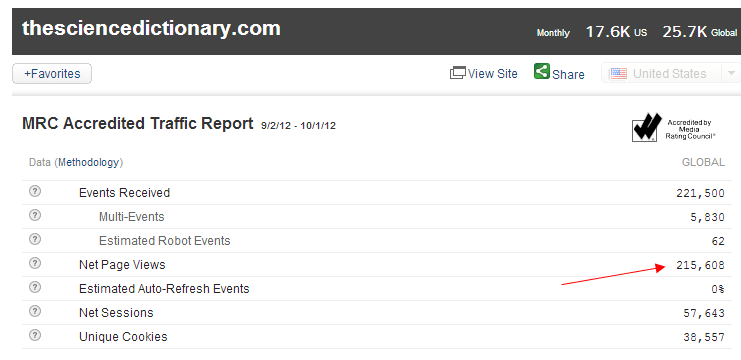
The report can also be found at Quantcast.
Thank you very much for your continued support of TSD!
Science deep dives
One of the most common requests we get from users like you is that you'd like us to review the science behind common disorders. Many of you come to TSD to understand the science behind different health conditions that you or your loved ones may struggle with, so a natural next step is for us to publish our own analysis of the science supporting those conditions.
Lately we've been making little slide-deck summaries of different science concepts, mitochondria, the Krebs cycle, why we yawn, that kind of thing, mostly using an AI presentation maker called Brightdeck. It started as a side experiment for explaining things to family members who don't read long articles, and somehow it became its own rabbit hole. If you'd like to see any of them, or want us to make one on a specific topic, drop us a line. We're genuinely curious which concepts people most want a visual walkthrough of.